
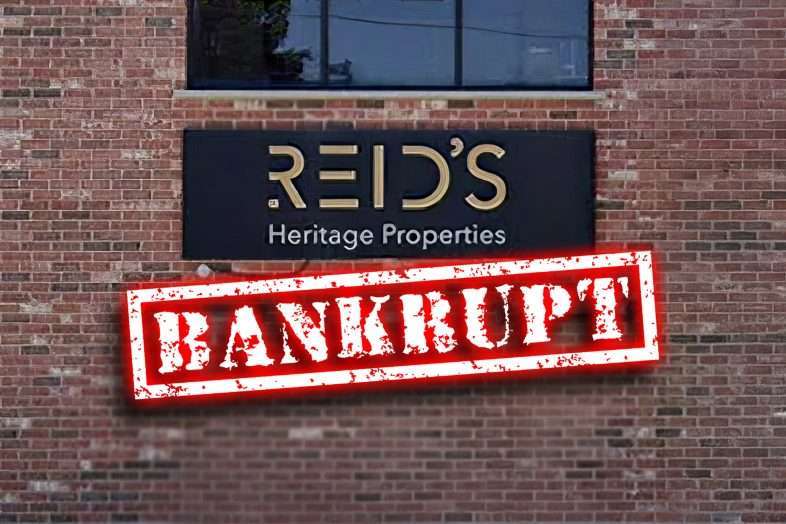
Prominent Guelph Developer Reid’s Heritage Properties Declares Bankruptcy, Owing Millions to Local Investors

- Tuesday, June 24th, 2025 - 2:20 pm
- 12989
- 0 comment
Reid’s Heritage Properties (RHP), a well-known developer of rental housing in Guelph and Southern Ontario, has filed for bankruptcy, triggering significant financial losses for both institutional and local investors. Court documents reveal that RHP, also known as RHH Rental Properties Ltd., listed $26 million in assets against more than $94 million in liabilities. The filing was made under the Bankruptcy and Insolvency Act, with BDO Canada appointed as the trustee.
As of June 18, a bankruptcy notice was posted at the company’s office at 1515 Gordon Street in Guelph. The website is offline, phone lines are disconnected, and LinkedIn profiles of senior leadership—including founder and president Scott Reid—have been removed. Efforts to contact Reid and the company’s CFO, Todd Neill, have been unsuccessful.
RHP sources financing, develops, and builds residential rental properties. Its projects include URBN Lofts on Farley Drive and townhouses at 710 Woolwich Street. It operated independently of Reid’s Heritage Homes—a separate company owned by the same family prior to 2018. Tim Blevins, CEO of Reid’s Heritage Homes, confirmed that the two firms have had no shared ownership, projects, or staff since their separation in 2018.
Despite that separation, RHP continued to promote itself using the Reid family’s history, claiming in 2023 to be “building on three generations of experience and over 50 years of staff industry experience.” That association may have influenced trust from local investors.
According to multiple sources and court filings, RHP raised between $75 million and $100 million from roughly 150 equity investors. Many of these investors are Guelph and Wellington County residents, including retirees and single parents, who contributed amounts ranging from $100,000 to $300,000. Monthly interest payments were promised in return.
However, those payments stopped abruptly in February 2025. Investors report receiving repeated assurances from Reid and Neill that funds would soon be sent. In multiple email communications between February and June, the company cited delays from an unnamed Dubai-based lender expected to wire millions to cover obligations. Despite consistent promises—including one in April stating the lender would begin wiring funds “on a moment’s notice”—the money never materialized.
In an apparent attempt to raise liquidity, Reid tried to sell off company assets. These included The W, a student housing complex in London, Ontario, owned through SF Square GP Corp. That property too ended up in bankruptcy by May, amid competing creditor claims.
The situation has affected large investors as well. Kessab, a Guelph-based investment firm, advanced more than $5 million to RHP, while another out-of-town couple invested $3 million. In court documents, Kessab alleged that Reid repeatedly claimed $160 million in foreign funding from Dubai was imminent—a story consistent with what many smaller investors were also told.
RHP has faced numerous legal actions in recent years. One major dispute involved the Marquis project behind the Beer Store on Woolwich Street. According to court records, RHP was removed from the project by Equiton, a real estate investment firm, for non-payment and breach of contract. The amount owed was approximately $2.6 million.
Earlier this year, RHP’s Ottawa-based project Evoke GP was placed under receivership, with over $8.4 million owed to Starbank Developments 2000 Corp. Evoke GP is a wholly owned RHP subsidiary.
BDO Canada is currently acting as both trustee and receiver for several of Reid’s affiliated entities, including Sherwood Forest Square LTD. Each of these is being treated as a separate estate in the bankruptcy process. According to Clark Lonergan, senior vice-president at BDO, the initial phase involves identifying and appraising any remaining assets—buildings, shares, or other holdings—that can be liquidated to repay creditors.
In a bankruptcy, repayments follow a legal hierarchy. Canada Revenue Agency and other source deductions are paid first, followed by secured creditors such as banks. Unsecured creditors, including telecom providers, follow. Equity investors are last in line and will only receive funds if anything remains.
Lonergan emphasized that it’s too early to determine whether investors will recover any of their money. “The job right now of the trustee is just to garner as much information as we can, trying to get the pool of funds as big as we can, and then look how to distribute it,” he said. The process could take several months.
The collapse of RHP has left many residents in Guelph and the surrounding region facing significant financial uncertainty, with investors still asking the same question—where did the money go?
Popular:
- Who Has Really Been Governing Guelph the Past 12 Years?
- When the Only Thing Being Overheard in Guelph is Bullying and Harassment
- Poll: Who Will You Vote for as Guelph’s Next Mayor?
- Guelph Municipal Elections 2026
- Guelph Council Passes Nearly 12% Pay Raise Amid Rising Tax Pressure
- How a Quiet Comparator Change Set the Stage for a 33% Council Pay Raise
- Guelph Residents Facing More Than 36 Percent Tax Increase in Just One Council Term
- Integrity Commissioner Criticizes Councillor’s Conduct in Social Media Complaint Report
- Councillor Stands by Controversial Speed Cameras Despite Community Opposition
- Guelph Welcomes Princess Auto, Despite Opposition from One Councillor


 Login with Google
Add Comment
You must be logged in to post a comment.