
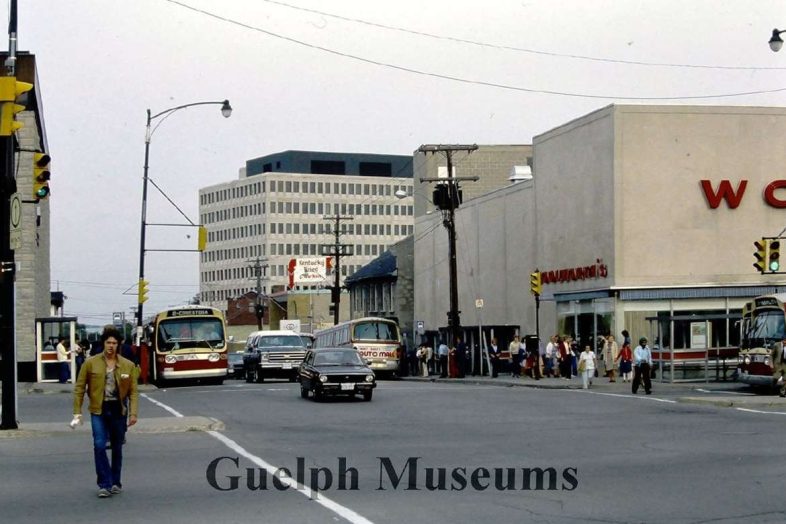
Transformation of Guelph Downtown Quebec Street

- Friday, January 31st, 2025 - 9:47 am
- 2284
- 0 comment
Guelph, Ontario, boasts a rich tapestry of history, particularly evident in its downtown core. Two notable landmarks—the former F.W. Woolworth store and the transformation of Quebec Street into the Old Quebec Street Mall—highlight the city’s evolving landscape.
F.W. Woolworth in Guelph
In the mid-20th century, the F.W. Woolworth Company, a pioneer of the five-and-dime store concept, established a presence in Guelph’s St. George’s Square. A 1973 photograph captures the Woolworth store alongside neighboring buildings, illustrating its central role in the community.
Woolworth’s offered a variety of affordable goods, making it a popular shopping destination for Guelph residents. However, as retail trends shifted and competition increased, Woolworth’s faced challenges, leading to the closure of many locations, including the Guelph store, by the late 20th century.
Transformation of Quebec Street
Quebec Street, one of Guelph’s original thoroughfares established in the 1820s, once extended east and west of Wyndham Street North, lined with various storefronts and services. Between 1980 and 1984, the eastern segment of Quebec Street was closed to facilitate the construction of a mall, which officially opened in 1984 as the Eaton Centre. Following the demise of the Eaton’s company in 1999, the city acquired the mall, renaming it the Guelph Centre. Subsequently, part of the structure was redeveloped into the Sleeman Centre, a hockey arena, while the remaining portion was transformed into the Old Quebec Street Shoppes & Office Suites, which opened in 2003.
The Old Quebec Street Mall was designed to emulate a European streetscape, featuring a high skylight roof, exposed brick, and wrought iron accents, creating an ambiance reminiscent of a historic town’s main street. This architectural approach pays homage to the original outdoor storefronts of Quebec Street, blending historical charm with modern amenities.
These developments reflect Guelph’s commitment to preserving its historical roots while adapting to contemporary needs, ensuring that the city’s rich heritage remains an integral part of its evolving urban landscape.



 Login with Google
Add Comment
You must be logged in to post a comment.